





Οι Δήμοι του Νοτίου Αιγαίου λένε «όχι» στις στρατηγικές επενδύσεις στον τουρισμό!
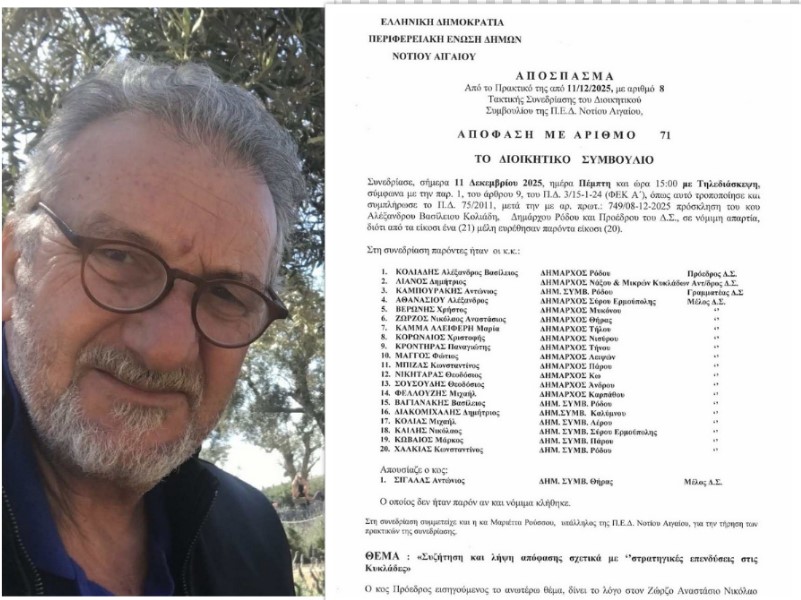
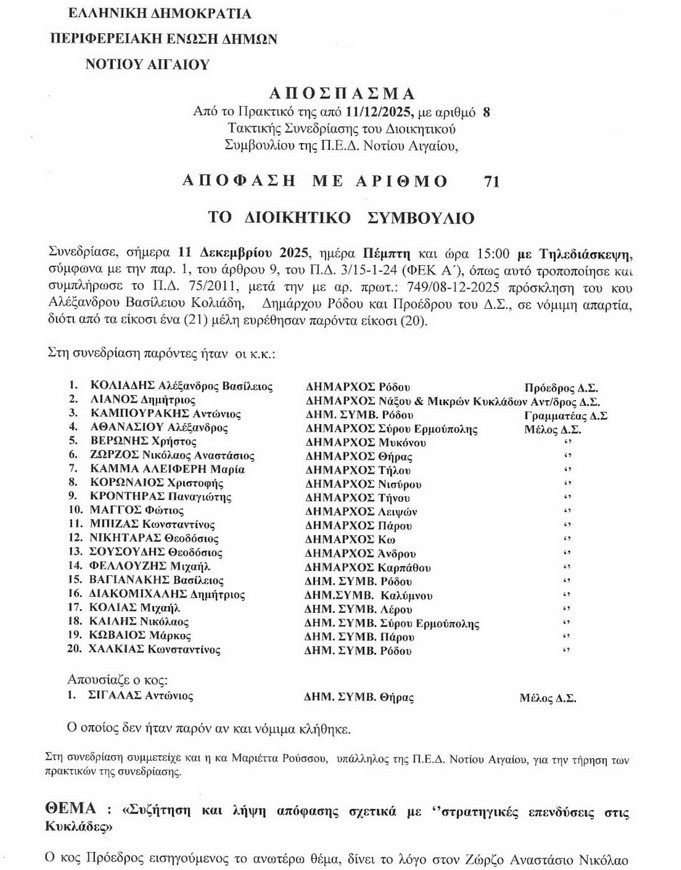
Μια σημαντική θετική εξέλιξη σημειώθηκε πρόσφατα. Η Περιφερειακή Ένωση Δήμων (Π.Ε.Δ.) Νοτίου Αιγαίου, το συλλογικό όργανο που εκπροσωπεί τους Δήμους, υιοθέτησε ομόφωνα (Απόφαση 71, Τακτική Συνεδρίαση 11/12/2025) ένα κείμενο ενάντια στις στρατηγικές επενδύσεις στον τουρισμό και γενικότερα στην επιχειρηματική δραστηριότητα real estate στα νησιά.
Το κείμενο αποτελεί εισήγηση του Δημάρχου Θήρας, Νίκου Ζώρζου, προς την Π.Ε.Δ. Το παραθέτουμε ολόκληρο παρακάτω, με σύντομο σχολιασμό μας. Το κείμενο αξίζει να διαβαστεί, τόσο για τις διαπιστώσεις όσο και για τις προτάσεις που κάνει.
Η ομόφωνη αποδοχή του κειμένου από το συλλογικό όργανο των Δημάρχων Νοτίου Αιγαίου είναι μια σημαντική εξέλιξη. Δείχνει ότι η προώθηση των στρατηγικών επενδύσεων και του real estate στα νησιά υπό τον μανδύα της ανάπτυξης, της ευημερίας, της αειφορίας, κλπ, είναι παραπλανητική. Τα διαφημιστικά δημοσιεύματα και εκδηλώσεις για τα επενδυτικά αυτά σχέδια, παραποιούν την πραγματικότητα, αποσκοπώντας στον πλουτισμό των ιδιωτών επενδυτών. Η υποστήριξη των σχεδίων από κυβερνητικούς παράγοντες φανερώνει ή άγνοια της κατάστασης ή στόχευση στο ιδιωτικό συμφέρον των επενδυτών σε βάρος του δημοσίου.
Με το κείμενό τους, οι Δήμαρχοι φαίνεται ότι αντιλαμβάνονται ότι οι στρατηγικές επενδύσεις και το real estate στα νησιά αυτά θα αλλοιώσουν την φυσιογνωμία των τόπων και θα δυσχεράνουν την ζωή και την οικονομική κατάσταση των μόνιμων κατοίκων. Είναι σημαντικό που οι Δήμαρχοι τοποθετούνται δημόσια με τον τρόπο αυτό, δηλώνοντας με θάρρος την αντίθεσή τους σε πολιτικές που προωθούνται από την κυβέρνηση – τόσο αυτή όσο και τις προηγούμενες.
Αν οι Δήμαρχοι κρατήσουν τα επόμενα χρόνια την στάση που εκφράζεται στο κείμενο, αυτό θα επηρεάσει σημαντικά την (μη) αποδοχή των «στρατηγικών» επενδυτικών σχεδίων και τον χωροταξικό σχεδιασμό στα νησιά. Χρησιμοποιώντας μια φράση από το κείμενο, ο χωροταξικός σχεδιασμός θα πρέπει να λάβει υπ’όψη ότι «Η Σαντορίνη, η Ίος, η Μήλος, η Σίκινος, η Φολέγανδρος και άλλα νησιά των Κυκλάδων δεν είναι πεδία για Φαραωνικά επιχειρηματικά σχέδια – είναι ζωντανοί τόποι.»
Το πλήρες κείμενο παρακάτω, με σύντομο σχολιασμό μας.
Το κείμενο ξεκινά περιγράφοντας με σκληρή γλώσσα την κατάσταση που επικρατεί στα νησιά.
«Τα τελευταία χρόνια, οι λεγόμενες «στρατηγικές επενδύσεις» για τον τουρισμό έχουν μετατραπεί σε όχημα αλλοίωσης, του φυσικού, πολιτιστικού και κοινωνικού ιστού των νησιών μας.
Ένα θεσμικό πλαίσιο, που υποτίθεται ότι θα έφερνε βιώσιμη ανάπτυξη, χρησιμοποιείται πλέον για να παρακάμπτει τους Δήμους, να αγνοεί τη φέρουσα ικανότητα και να εξυπηρετεί ιδιωτικά συμφέροντα σε βάρος του δημοσίου.
Οι τοπικές κοινωνίες των Κυκλάδων αντιδρούν, γιατί βλέπουμε να απειλείται η ίδια η υπόσταση των νησιών μας. Μεγάλοι οικισμοί σε εκτός σχεδίου περιοχές ξεφυτρώνουν σαν μανιτάρια, κυρίως στα μικρά και μεσαία νησιά, μέσω των γνωστών «εργαλείων τουριστικής ανάπτυξης»: τα Σύνθετα Τουριστικά Καταλύματα που χτίζονται χωρίς υποχρέωση πολεοδόμησης, τους Οργανωμένους Υποδοχείς Τουριστικών Δραστηριοτήτων που προωθούνται μέσω Ειδικών Πολεοδομικών Σχεδίων και τις Στρατηγικές Επενδύσεις που υλοποιούνται μέσω των ΕΣΧΑΣΕ. Σε όλες αυτές τις περιπτώσεις, η επιλογή των εκτάσεων γίνεται από ιδιώτες και όχι μέσα από δημόσιο σχεδιασμό.
Το χαρακτηριστικό όλων αυτών των σχεδίων είναι ότι ο Τουρισμός αντί να αποτελεί στόχο παραγωγής υπεραξίας για την τοπική κοινωνία, μετατρέπεται σε χώρος για την ογκώδη πολυτέλεια κατοικιών προς πώληση ή μίσθωση – δηλαδή σε καθαρό real estate, έναν μη παραγωγικό κλάδο που όμως κυριαρχεί. Επί πλέον η συνένωση εκτάσεων εκτός σχεδίου για την ανέγερση επαύλεων, χωρίς καμία σχέση με την κλίμακα των οικισμών ή των νησιών, αλλοιώνει ριζικά και το τοπίο. Οι ΟΤΑ δεν έχουν λόγο ούτε δικαίωμα άποψης για όσα συμβαίνουν εντός των ορίων τους.»
Το κείμενο συνεχίζει με αναφορά σε παραδείγματα νησιών. Η Ίος είναι πρώτη!
«Στην Ίο, το 30% του νησιού έχει συγκεντρωθεί στα χέρια ενός επενδυτή με σχέδια που χαρακτηρίστηκαν στρατηγικές επενδύσεις, παρά τις αρνητικές αποφάσεις του Δημοτικού Συμβουλίου.
Στη Μήλο, η υπόθεση του Σαρακήνικου αποκάλυψε την αυθαιρεσία και τη μη τήρηση των αποφάσεων του ΣτΕ και ανάγκασε το Υπουργείο να ανακαλέσει οικοδομική άδεια, αφού είχε ήδη τραυματιστεί τοπίο μοναδικής ομορφιάς.
Στη Σίκινο, ο Δήμος πήρε καθαρή θέση, θεσπίζοντας αυστηρούς περιορισμούς στη δόμηση και λέγοντας με αποφασιστικότητα «όχι» στην άναρχη ανάπτυξη.
Η Φολέγανδρος και η Ανάφη ζουν την ίδια αγωνία, βλέποντας τις πιέσεις να αυξάνονται.»
Το κείμενο συνεχίζει ασκώντας κριτική στο σύστημα έγκρισης και αδειοδότησης των «στρατηγικών επενδύσεων», από επιτροπές της Αθήνας και χωρίς την έγκριση των τοπικών κοινωνιών. Θα προσθέταμε εδώ και την αδιαφάνεια και διαβλητότητα των διαδικασιών.
«Η Θήρα δεν μένει απαθής. Δηλώνουμε καθαρά ότι είμαστε αντίθετοι με την ένταξη οποιουδήποτε έργου στα καθεστώτα στρατηγικών επενδύσεων όταν αυτό δεν έχει την αποδοχή της τοπικής κοινωνίας και δεν ελέγχεται ως προς τη συμβατότητά του με το Ειδικό Πολεοδομικό Σχέδιο και τη φέρουσα ικανότητα του νησιού.
Το μοντέλο που επιτρέπει να αποφασίζεται η τύχη ενός τόπου από επιτροπές της Αθήνας δεν μπορεί να συνεχιστεί. Δεν είναι αναπτυξιακό εργαλείο οι στρατηγικές επενδύσεις, είναι εργαλείο αποδιάρθρωσης και καταστροφής των νησιών μας.
Ως Δήμαρχος εμβληματικού νησιού των Κυκλάδων, αναλαμβάνω την πρωτοβουλία να φέρω το ζήτημα αυτό στο επίκεντρο της συζήτησης των Δήμων.
Η Σαντορίνη, που βιώνει καθημερινά τα θέματα υπέρβασης της φέρουσας ικανότητας, έχει χρέος να εκφράσει και τη φωνή μικρότερων νησιών που πιέζονται ακόμη περισσότερο.»
Το κείμενο καταλήγει με τέσσερις προτάσεις.
«Ζητούμε από την ΠΕΔ Νοτίου Αιγαίου να αναλάβει άμεσα πρωτοβουλία για κοινό ψήφισμα των Δήμων των Κυκλάδων, ώστε:
1. Να ανασταλεί κάθε διαδικασία αδειοδότησης στρατηγικών επενδύσεων που δεν έχουν τη συναίνεση των τοπικών κοινωνιών,
2. Να κατοχυρωθεί θεσμικά η υποχρεωτική συμμετοχή των Δήμων στη γνωμοδότηση και στην έγκριση τέτοιων έργων,
3. Να θεσπιστεί ότι κανένα επενδυτικό σχέδιο δεν μπορεί να υλοποιηθεί χωρίς έλεγχο φέρουσας ικανότητας και πλήρη συμβατότητα με τα Ειδικά ή Τοπικά Πολεοδομικά Σχέδια,
4. Και τέλος να εξεταστεί θεσμικά η κατάργηση του πλαισίου των στρατηγικών επενδύσεων και η απαγόρευση όλων των μορφών που συνδυάζουν Τουρισμό και real estate στον νησιωτικό χώρο, όπου οι αντοχές της γης και των κοινωνιών είναι πεπερασμένες.
Η Σαντορίνη, η Ίος, η Μήλος, η Σίκινος, η Φολέγανδρος και άλλα νησιά των Κυκλάδων δεν είναι πεδία για Φαραωνικά επιχειρηματικά σχέδια – είναι ζωντανοί τόποι.»
Το ΔΣ της ΠΕΔ αποφάσισε ομόφωνα να συναινέσει με την παραπάνω εισήγηση και να προτείνει τις προτάσεις 1-4 παραπάνω.
//
The Municipalities of the South Aegean Say “No” to Strategic Tourism Investments!
A significant positive development has taken place recently. The Regional Union of Municipalities (P.E.D.) of the South Aegean, the collective body representing the municipalities, unanimously adopted (Decision 71, Regular Meeting 11/12/2025) a text opposing strategic investments in tourism and, more broadly, real estate business activity on the islands.
The text is a proposal submitted by the Mayor of Thira (Santorini), Nikos Zorzos, to the P.E.D. We reproduce it in full below, along with brief commentary of our own. The text is well worth reading, both for its assessments and for the proposals it puts forward.
The unanimous acceptance of the text by the collective body of the Mayors of the South Aegean is a significant development. It shows that the promotion of strategic investments and real estate on the islands, under the guise of development, prosperity, sustainability, etc., is misleading. Promotional publications and events for these investment plans distort reality, aiming at the enrichment of private investors. The support of these plans by government officials reveals either ignorance of the actual situation or a deliberate prioritization of private investor interests at the expense of the public interest.
Through their text, the Mayors appear to recognize that strategic investments and real estate activity on these islands will alter the character of the places and worsen the living conditions and economic situation of permanent residents. It is important that the Mayors take a public stance in this way, courageously declaring their opposition to policies promoted by the government—both the current one and previous administrations.
If the Mayors maintain in the coming years the position expressed in this text, it will significantly affect the (non-)acceptance of “strategic” investment plans and spatial planning on the islands. Using a phrase from the text, spatial planning must take into account that:
“Santorini, Ios, Milos, Sikinos, Folegandros, and other Cycladic islands are not fields for pharaonic business schemes—they are living places.”
The full text follows below, with brief commentary.
The text begins by describing, in stark language, the situation prevailing on the islands:
“In recent years, so-called ‘strategic investments’ in tourism have been transformed into a vehicle for the distortion of the natural, cultural, and social fabric of our islands.
An institutional framework that was supposedly meant to bring sustainable development is now being used to bypass municipalities, ignore carrying capacity, and serve private interests at the expense of the public good.
Local communities in the Cyclades are reacting, because we see the very existence of our islands being threatened. Large residential developments in out-of-plan areas are springing up like mushrooms, mainly on small and medium-sized islands, through the well-known ‘tools of tourism development’: Integrated Tourist Resorts built without any obligation for urban planning; Organized Receivers of Tourist Activities promoted through Special Urban Planning Schemes; and Strategic Investments implemented through ESCHASE procedures. In all these cases, site selection is carried out by private actors rather than through public planning.
The common characteristic of all these projects is that tourism, instead of being a means of generating added value for the local community, is transformed into a space for bulky luxury residences for sale or rent—that is, into pure real estate, a non-productive sector that nevertheless comes to dominate. Moreover, the consolidation of out-of-plan land for the construction of villas, with no relation to the scale of settlements or the islands themselves, radically alters the landscape. Local authorities have neither a say nor the right to express an opinion on what takes place within their boundaries.”
The text then continues by referring to specific island examples, with Ios first:
“On Ios, 30% of the island has been concentrated in the hands of a single investor through plans designated as strategic investments, despite negative decisions by the Municipal Council.
On Milos, the Sarakiniko case revealed arbitrariness and non-compliance with rulings of the Council of State, forcing the Ministry to revoke a building permit—after a landscape of unique beauty had already been damaged.
On Sikinos, the Municipality took a clear stance, imposing strict building restrictions and decisively saying ‘no’ to uncontrolled development.
Folegandros and Anafi are experiencing the same anxiety, watching pressures intensify.”
The text continues with criticism of the approval and licensing system for “strategic investments,” which is handled by committees in Athens without the consent of local communities. We would add here the opacity and susceptibility to corruption of these procedures.
“Thira does not remain indifferent. We clearly state that we oppose the inclusion of any project in the strategic investment regimes when it does not have the acceptance of the local community and has not been assessed for compatibility with the Special Urban Planning Plan and the island’s carrying capacity.
A model that allows the fate of a place to be decided by committees in Athens cannot continue. Strategic investments are not a development tool; they are a tool for the dismantling and destruction of our islands.
As Mayor of an emblematic Cycladic island, I undertake the initiative to bring this issue to the forefront of discussion among the municipalities.
Santorini, which daily experiences the consequences of exceeding carrying capacity, has a duty to also express the voice of smaller islands that are under even greater pressure.”
The text concludes with four proposals:
“We call on the Regional Union of Municipalities of the South Aegean to immediately take the initiative for a joint resolution by the municipalities of the Cyclades, so that:
1. Any licensing process for strategic investments lacking the consent of local communities be suspended;
2. The mandatory participation of municipalities in the consultation and approval of such projects be institutionally secured;
3. No investment plan be implemented without a carrying capacity assessment and full compatibility with Special or Local Urban Planning Plans;
4. Finally, that the institutional abolition of the strategic investment framework be examined, along with a ban on all forms combining tourism and real estate in island regions, where land and social capacities are finite.
Santorini, Ios, Milos, Sikinos, Folegandros, and other Cycladic islands are not fields for pharaonic business schemes—they are living places.”
The Board of Directors of the P.E.D. unanimously decided to endorse the above proposal and to put forward proposals 1–4 as outlined.









Άλλο η Μήλος, η Ίος και η Νίσυρος και άλλο η Κως και η Ρόδος